Behold! Continuing and regular in-progress updates on my first attempt at a scratch-built 1:35 scale static waterline display model of a US Navy Arleigh Burke class DDG-51 type destroyer taking over half my garage, measuring in at a barely manageable 4.5 meters long. Currently under construction in Pierce County, Washington, in the shadow of Mt. Rainier and under the occasional flight paths of the blacked-out and transponders-off JBLM 160th Night Stalkers. This fever dream of a passion project commenced in July of 2025 by Nick Hoke, retired from a 27 year long career as a first responder. Before that there had been an enlistment and overseas adventures in the 1980’s navy as a Leahy-class guided missile cruiser helmsman and also a fair amount of time was spent at Ingall’s shipbuilding when my ship was in drydock. For a refit/NTU, not because of my steering. And before all that, back in the days before flying cars jetpacks and cell phones, I was a teenage Sea Cadet which was.. uh.. ffffff.. over forty years ago. So that’s my connection to matters of naval relevance here. Now it’s March 2026, month eight of my build and this project is doing a pretty good of distracting me occasionally from the reality of this absurd timeline. And it’s therapist approved. Also cheaper.
JULY 2025:
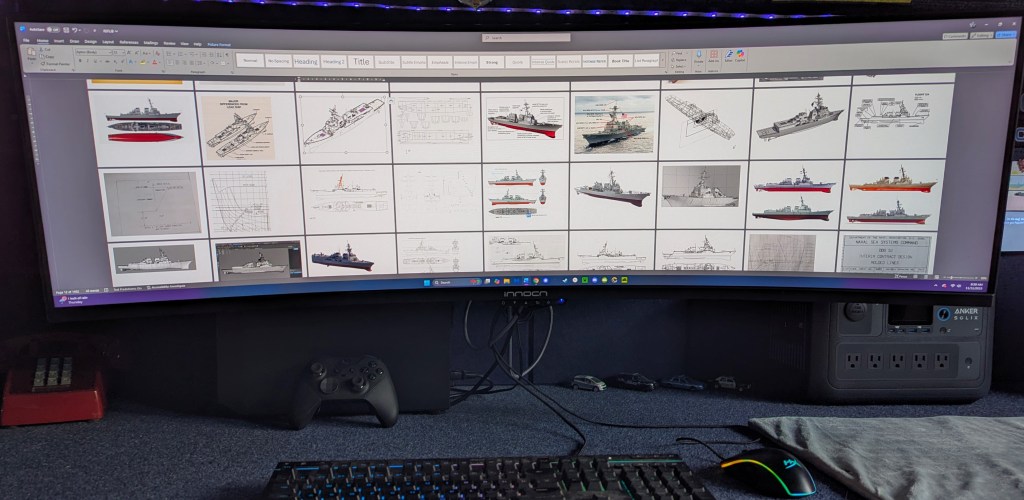
Step One: Submit a proposal to the proper authorities, of course. Permission was granted, funds authorized, and the project was launched. I started with research and development. I scoured the internet and curated a couple thousand reference photos from public open sources.
Frankenbench was resurrected, retooled and repurposed with a bolted-on fabulously lightweight level and rigid extension ladder that gave one up for team and is now missing the top 12 foot section. By the way, if you're looking at this on your phone.. it looks better on a bigger screen.
There are 74 of these DDG hulls commissioned and out on patrol, so there are almost enough public photos and images of them for me to study and reconcile different measurements and dimensions. I say "different" because I had noticed pretty quickly that between all the ships' different refits and flights, blocks and mods and baselines, virtually every individual ship has at least one noticeably different feature somewhere; many are minor, some are major. Built over decades now in different shipyards and upgraded in a dozen other different shipyards by many subcontractors, there is enough variance - that includes even paint colors and transom typography (!) - to give me a bit of leeway to relax my margin of error accuracy to roughly ±01.14% transversely and ±0.16% longitudinally.
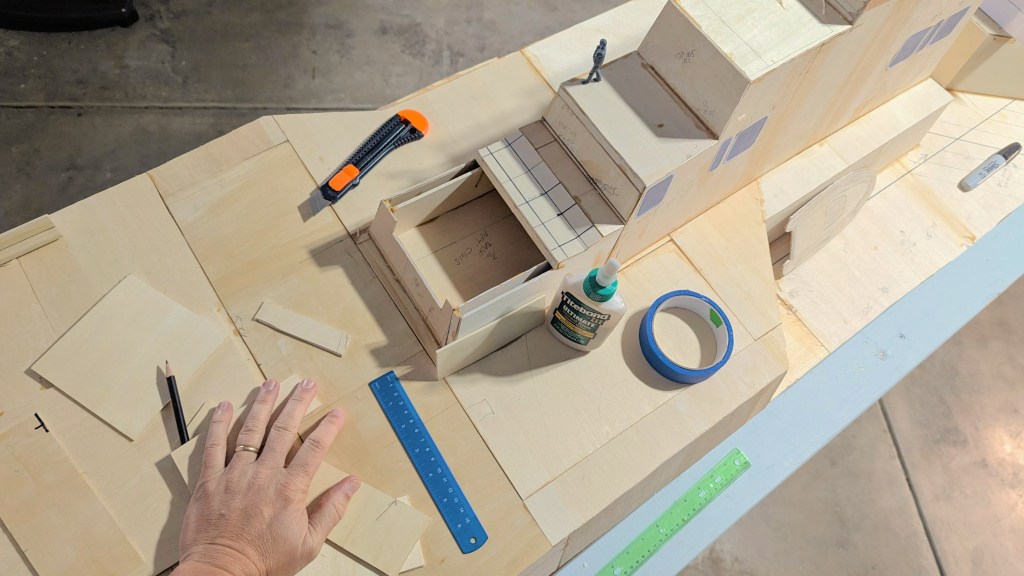
You've seen those little plywood laser cut decoration contraptions things, made out of hobby plywood? Yeah, that wood is sold in handy 12" x 12" square sheets, 3 mm thick. Absolutely perfect for building a boat like this. Cuttable by hand with cheap disposable utility knives. I wound up using 13 dozen of the wood square sheets and two dozen of the knives. And five quarts of wood glue.
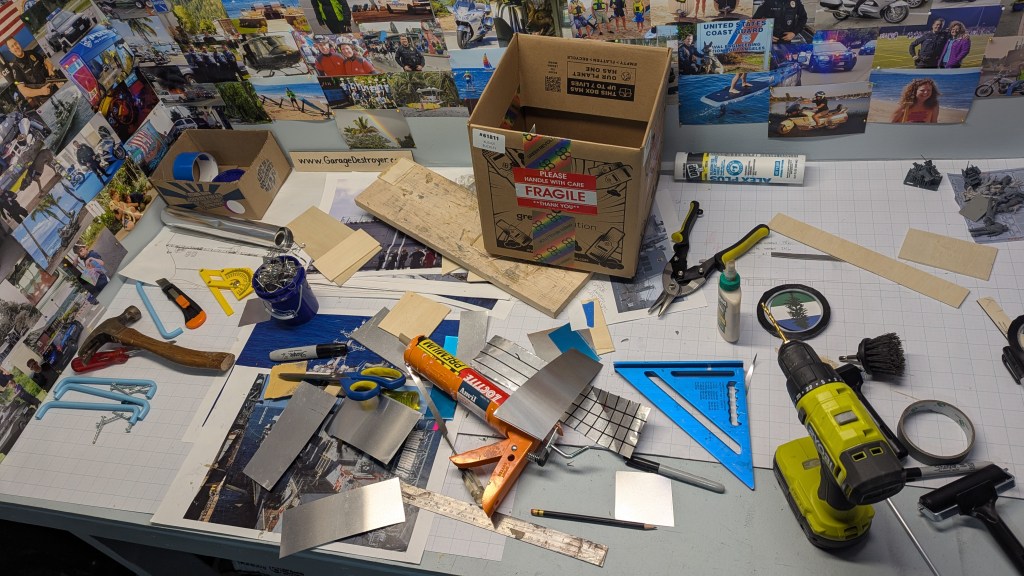
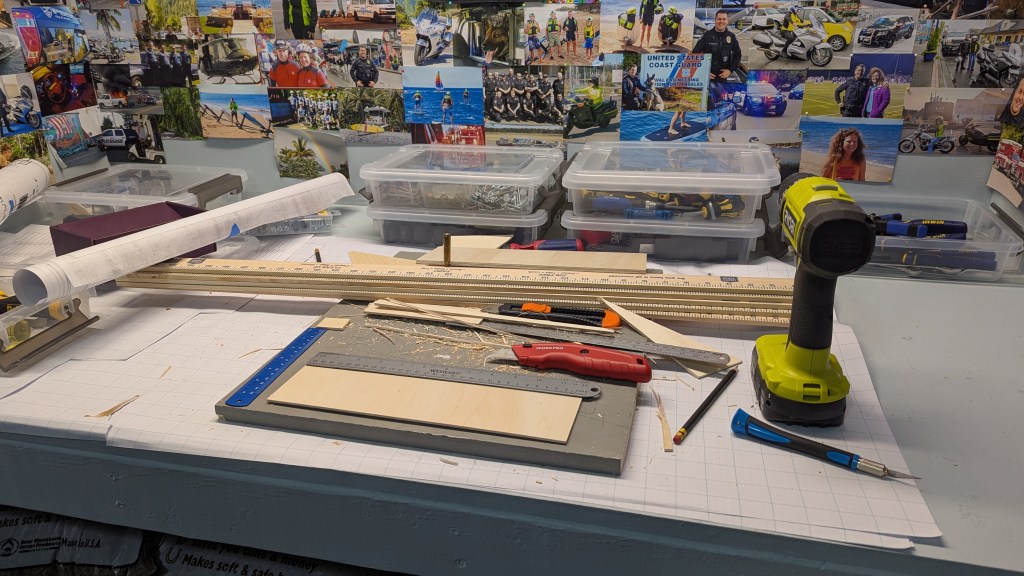
Frugality is one of my evident signature techniques. I could not find anywhere in my garage any kind of laser cutting or laser measuring machines, and there was no CAD anything. Only in my dreams. So this first phase was all done old-school Gen X style: I cut a few hundred pieces of wood and metal one at a time by hand into specifically measured different shapes to millimeter accuracy and glued them all together into a growing configuration of awkward looking weirdness. This was Phase I: the part with all the wood.
Does one need a huge workbench to build a ship? No, not really.
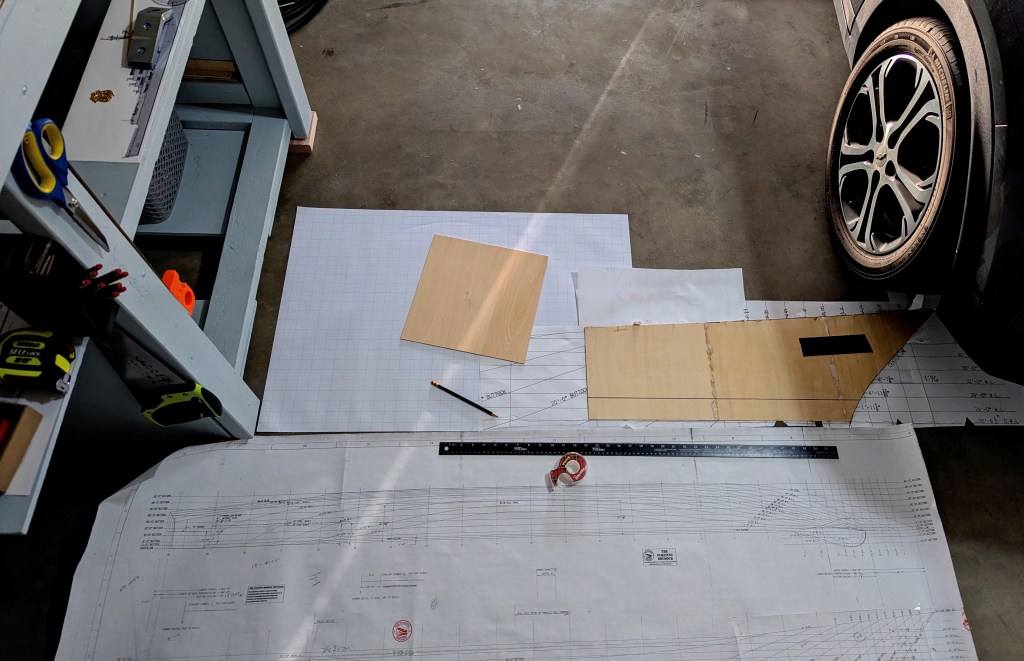
I only had to use the garage floor a couple of times.
My cutting boards were whatever scraps of thick wood I could find laying around.
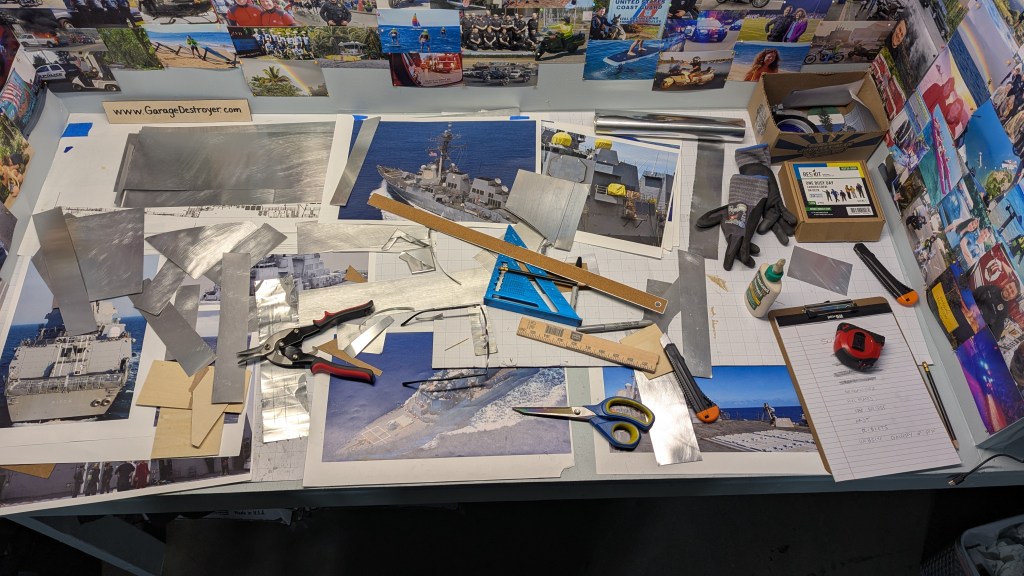
There was a bit of mathing and cross referencing involved in all of this. Dimensions, fractions, angles, scale conversions and measurements in both imperial and freedom units. I became familiar with the giant roll printer at the local fedex store. Also went through about a dozen pencils and a few notepads.
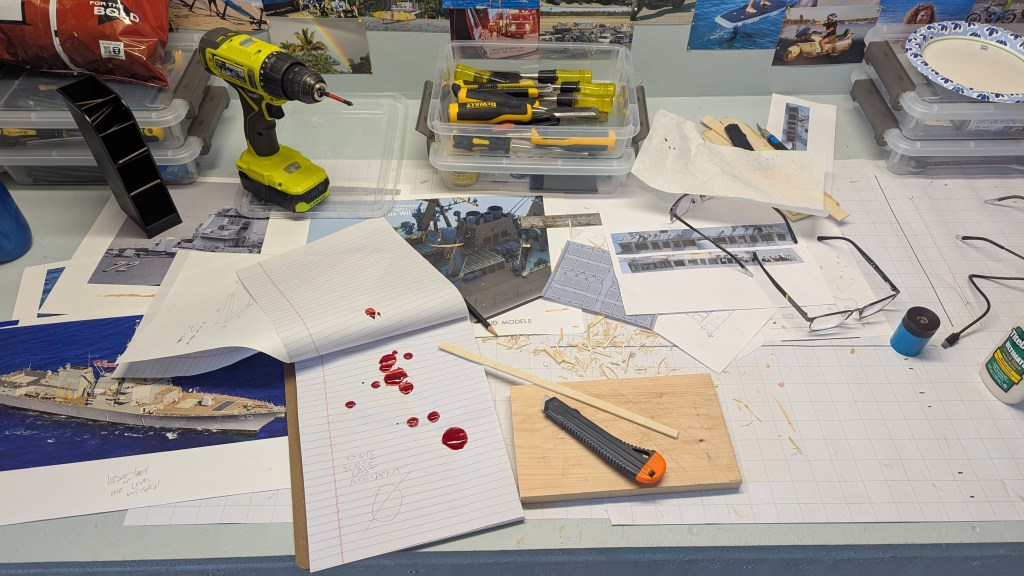
The ratio of hours worked / injuries sustained from slipped knives came to roughly weekly incidents of resetting the days since last injury counter back to zero.
Shoutout to the shipyard CFO for setting up a first aid station next to my workbench after seeing the frequency of the slips slices nicks stabbings and lacerations to the lead shipwright's appendages.
Both sharp and dull blades cut with equal regularity and varying severity.
If you want to make one of these yourself, I can save you tons of time because this whole thing was a learning experience and I learned a lot. If I were to sustain a major head injury and choose to do this again, it would take less than half the time than this one did because I was figuring everything out as I went along and there was a fair bit of trial and error.
You know it's not really a project until there's been some blood sweat and tears.
Graph paper is one of the ten essentials for a project like this.
Only one injury was serious enough to require a trip to the local urgent care to re attach my left arm.
As you can see, this is the first time I've ever attempted anything like this.
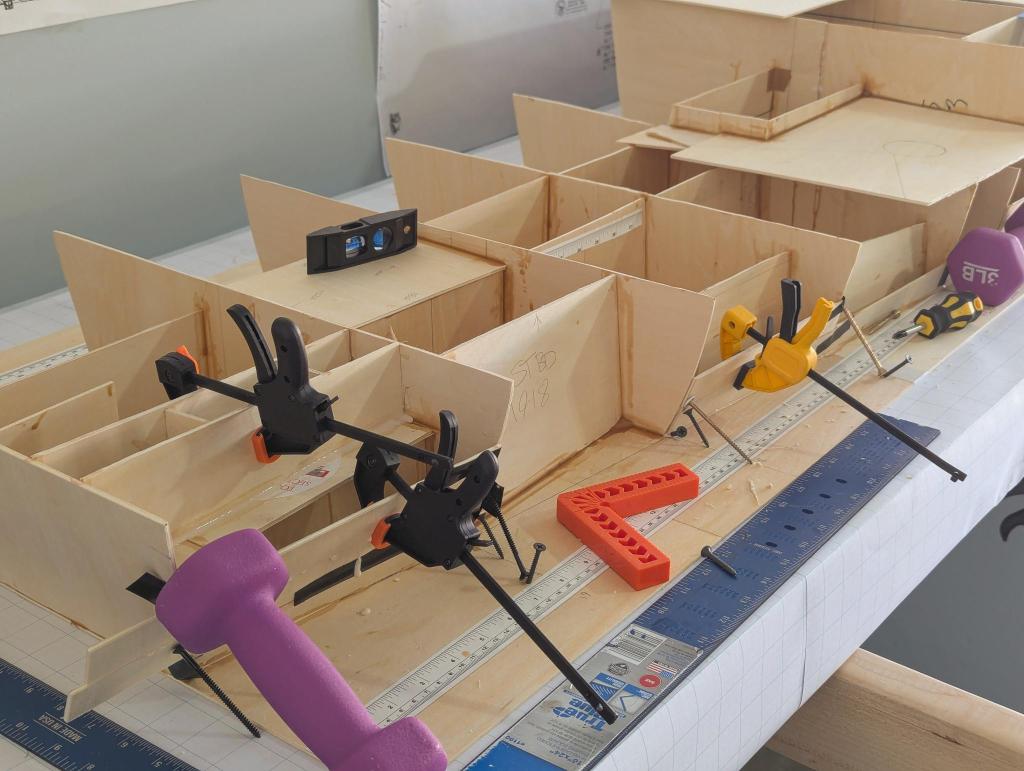
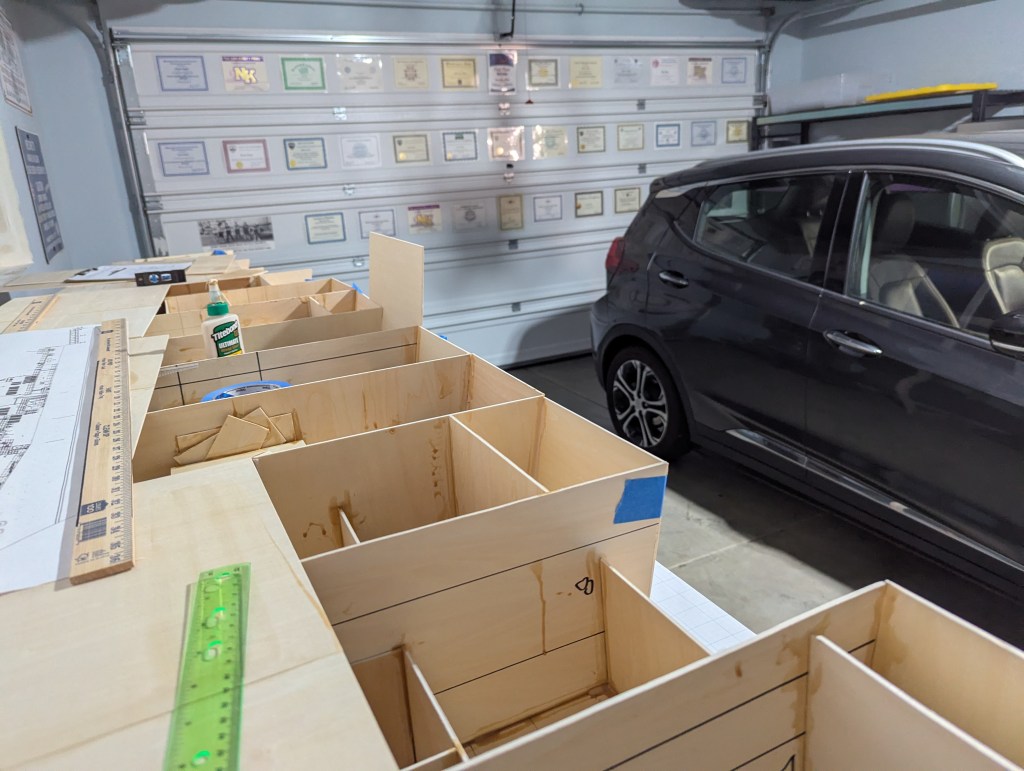
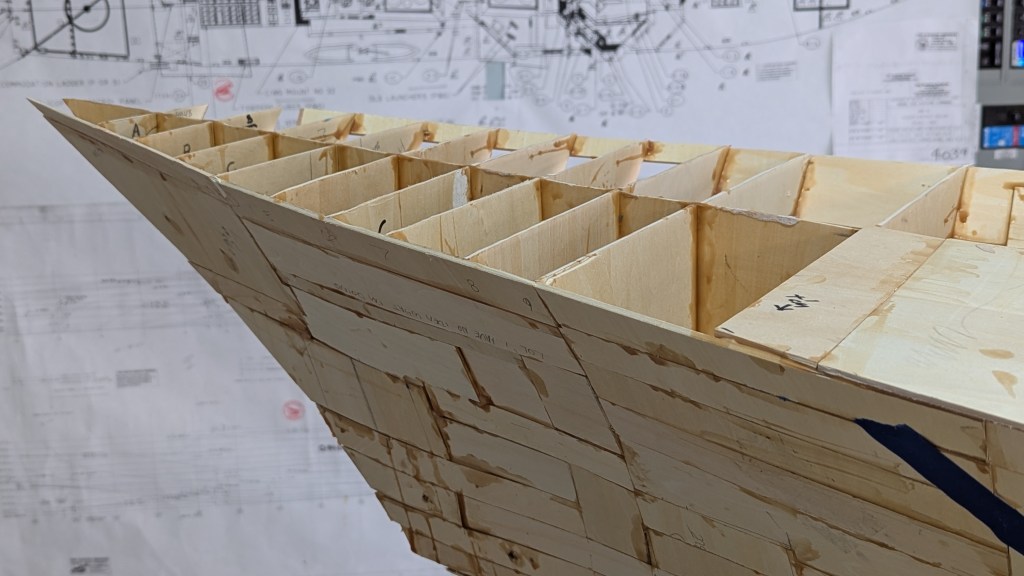
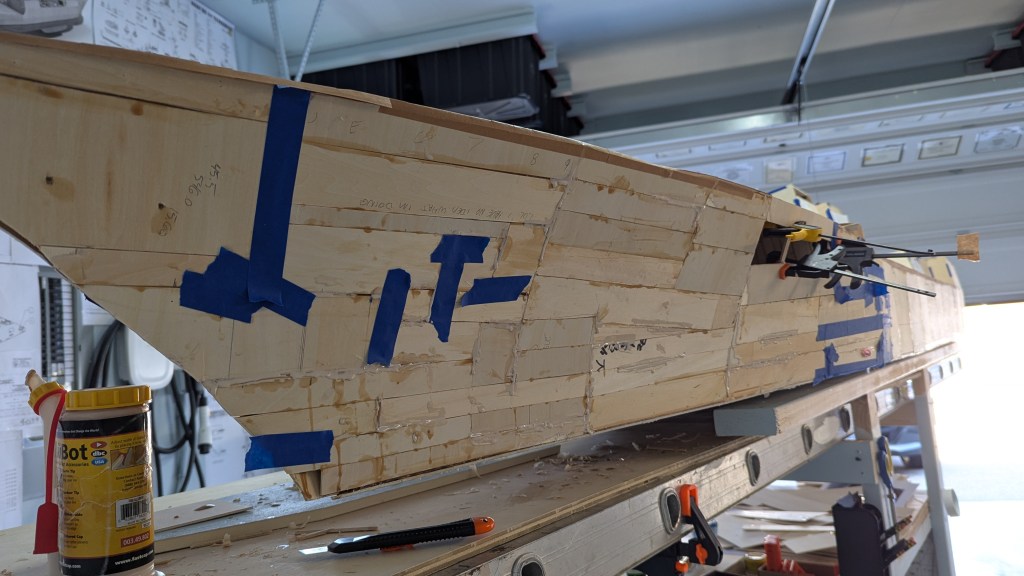
The wood hull didn't have to look pretty because two (!) layers of metal (!!) are going to cover it. I know half of you are cringing hard at this photo. I get it, it hurts me too.
Stem to stern longitudinal intercostals without general arrangement scantlings. If you know what that means you are probably also deeply amused by this photo.
 Some of you are wondering if you could tackle a project like this... I say yes you can. No prior experience is necessary but you will need a few rolls of painters tape.
This was in the second month.
Some parts were easier than others to assemble.
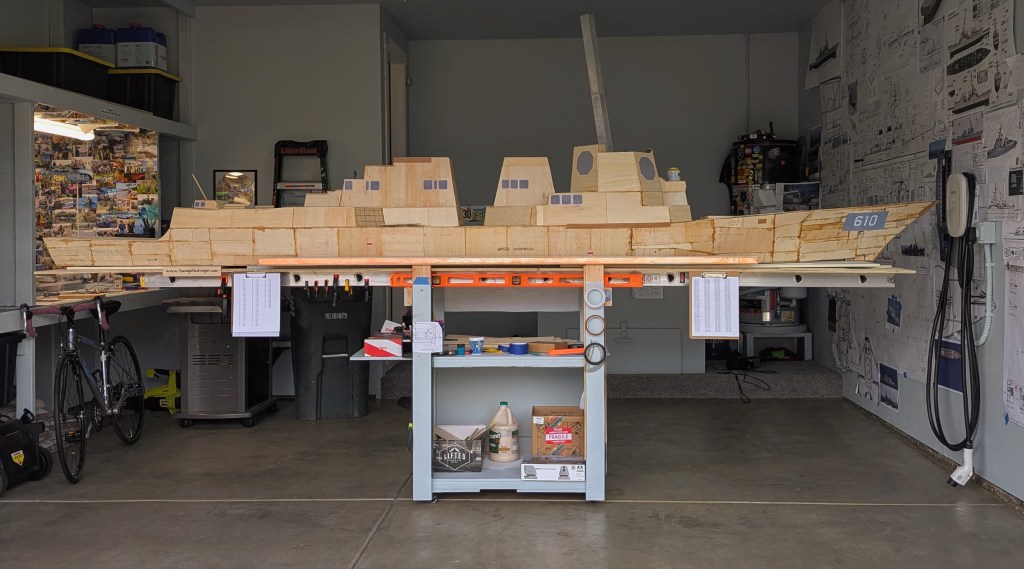
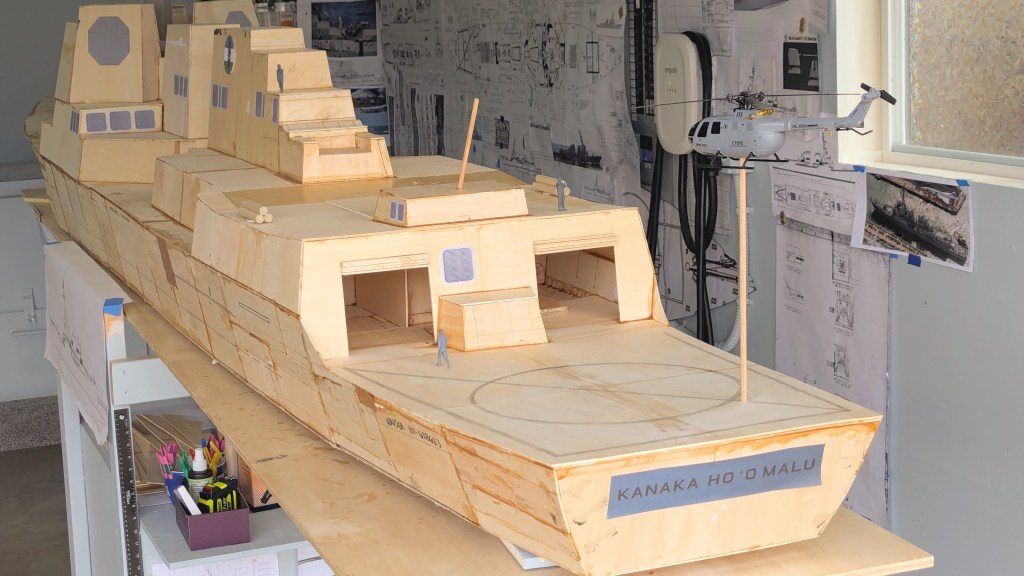
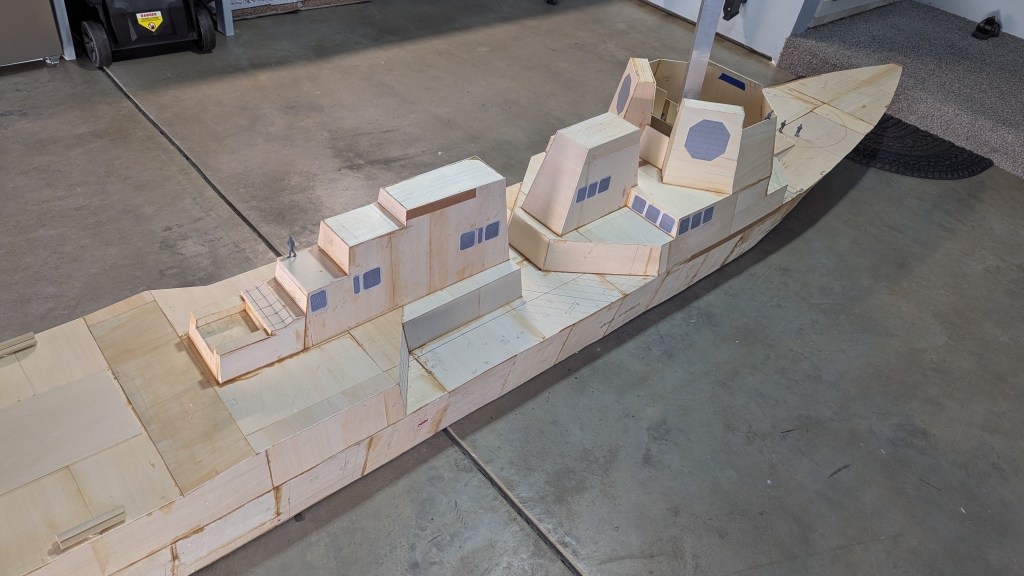
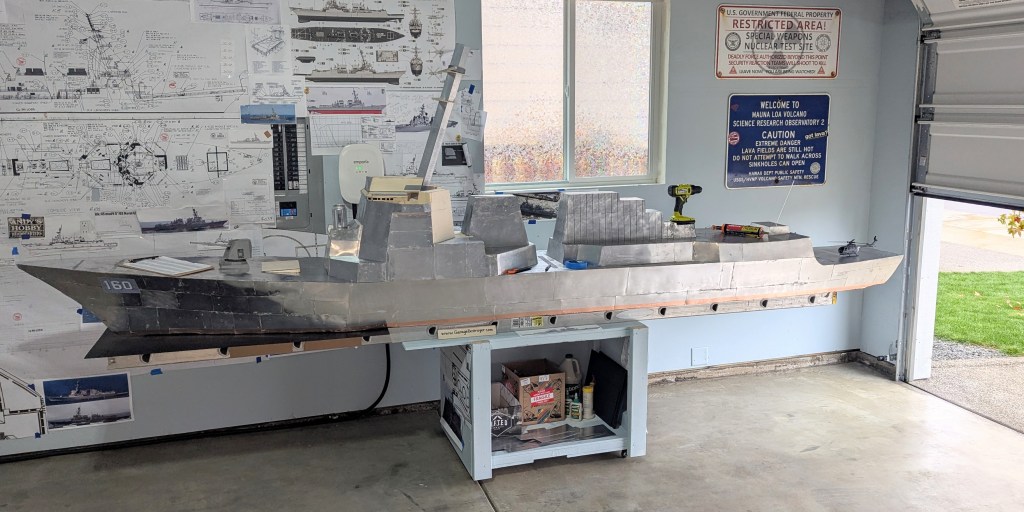
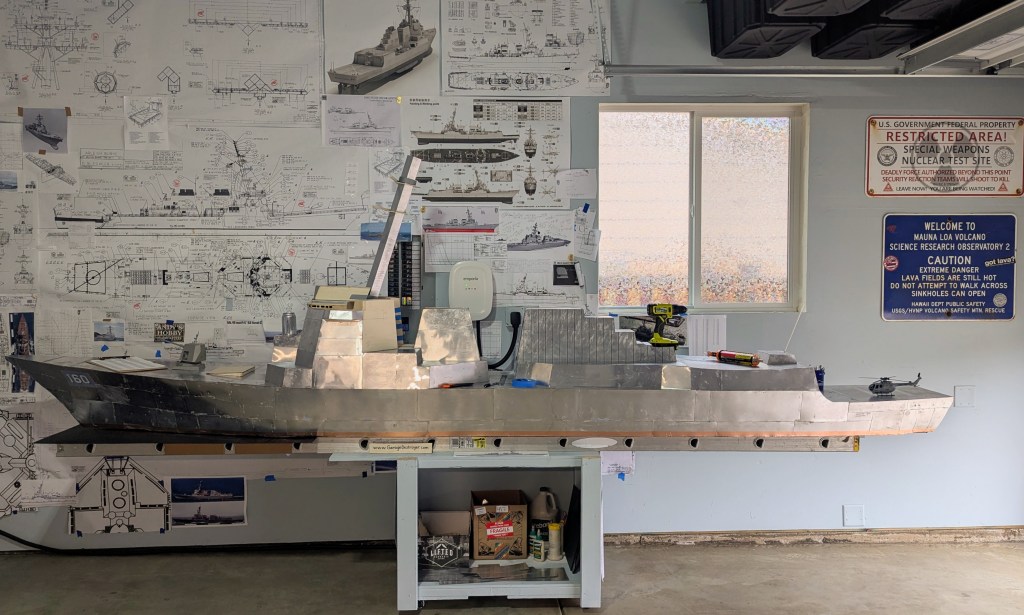
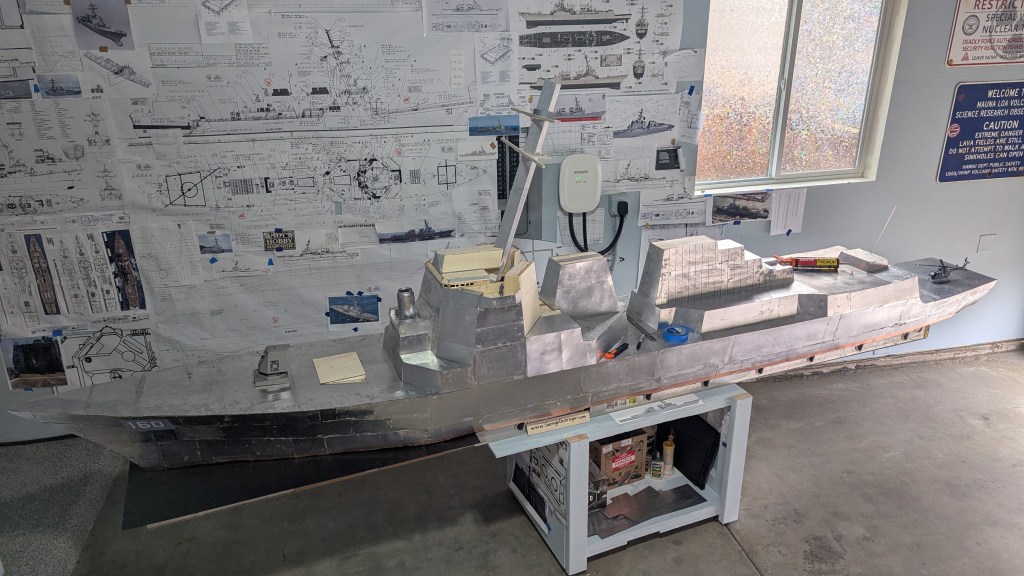
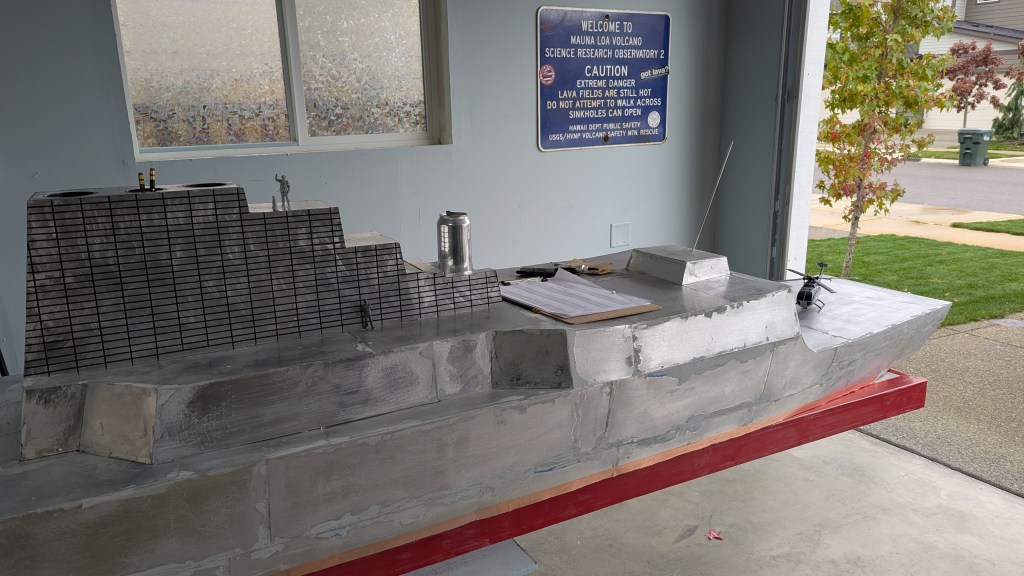
This scale model ship is almost 15 feet long. The lower hull took about a month to build, the hangers and aft deckhouse took another month, and the forward superstructure is still being worked on because reasons mostly related to geometry.
Why? Why is this guy doing this? Well.. I'm relentlessly creative. This project replaced my previous hobby, the one where I was a content creator on youtube, making scenery and travel videos complete with custom soundtracks. Right around the same time I reached a quarter million views and a thousand subscribers, I realized that the coming maelstrom flood of AI generated video and audio (both the good and bad kinds) would be too much for me. Time to pivot toward something less digital and more physical and make something with my hands.
It's surprisingly lightweight and sturdy. I will admit that more than two times I had to hammer out a large section somewhere due to misalignment and miscalculated measuring issues, which I had figured would probably happen so it didn't hurt too much. For your viewing pleasure I thought about including the embarrassing photos of those, uh, learning experiences but tbf they looked too much like either the USS Cole, the USS Fitzgerald or USS John S. McCain on their worst days and it's still too soon.
I listened to chill music and podcasts while doing this and (tried to) ignore the news; this is one of my happy places.
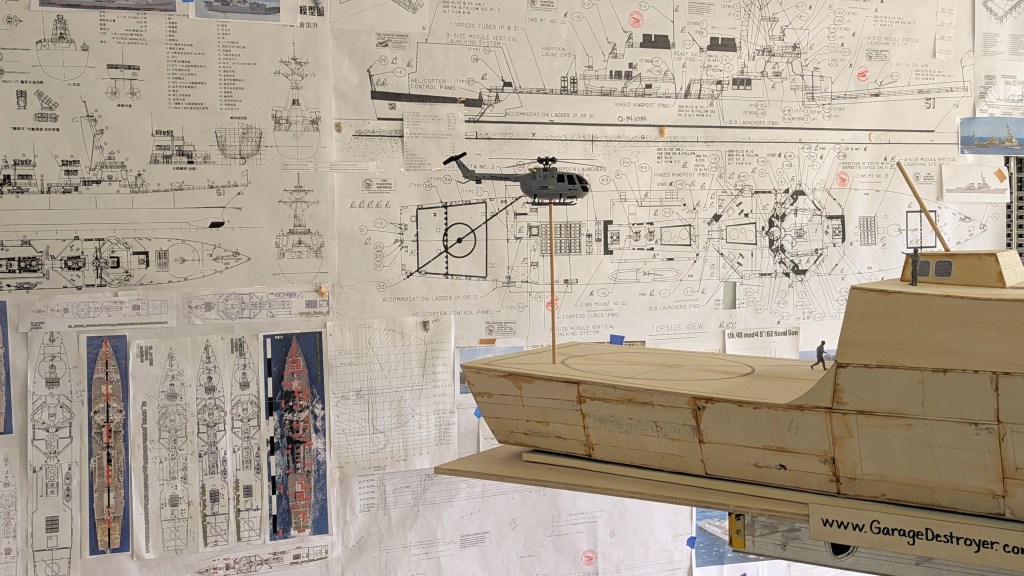
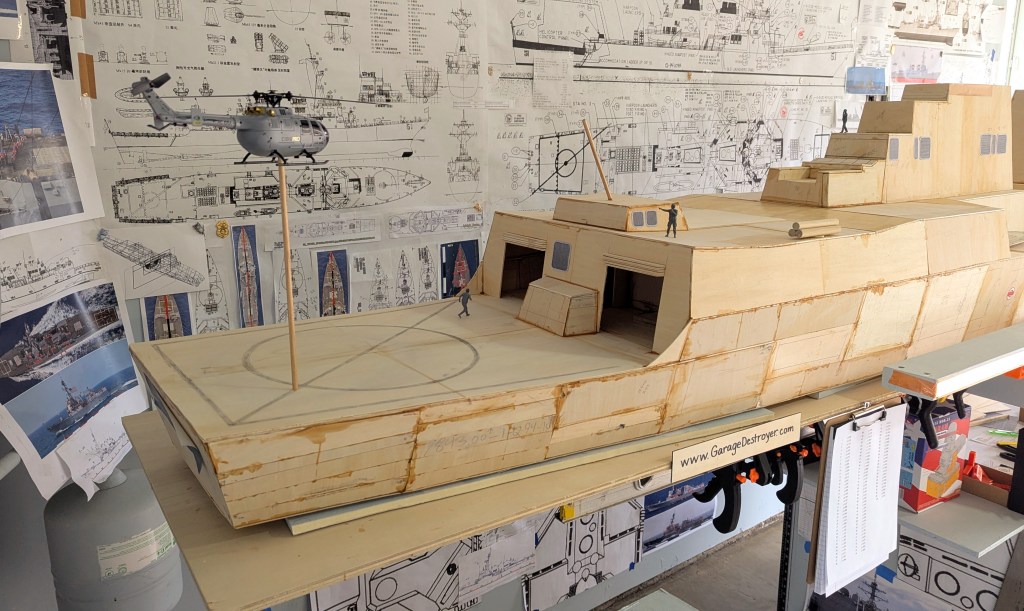
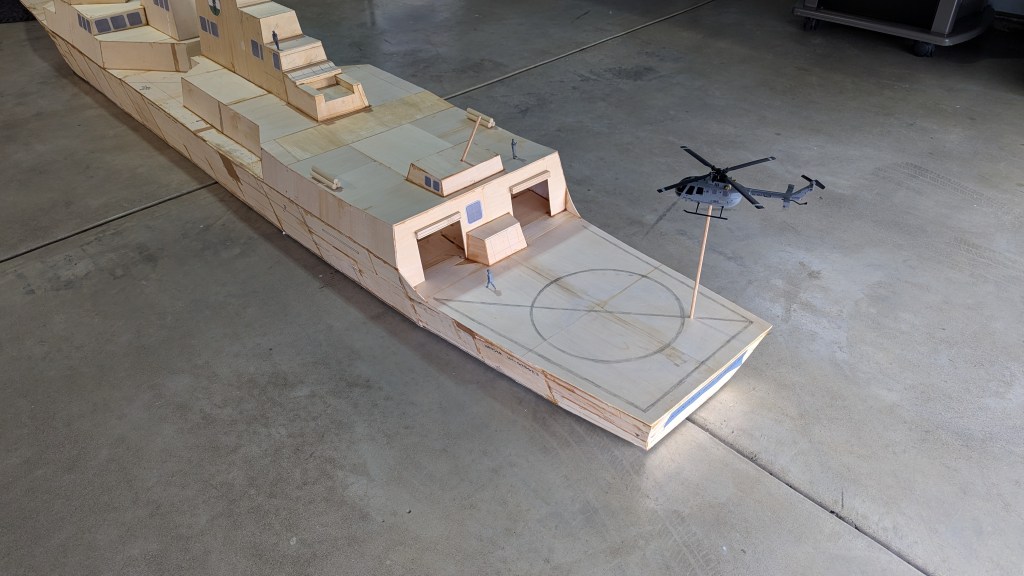
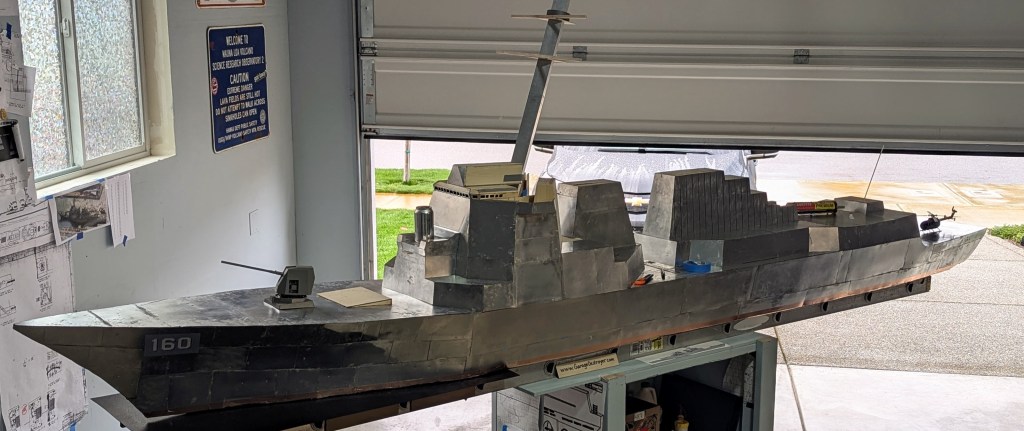
Yes yes I know this is the wrong kind of helicopter; it's a placeholder.
The flight deck will eventually get a proper MH-60R 1/35 scale model.
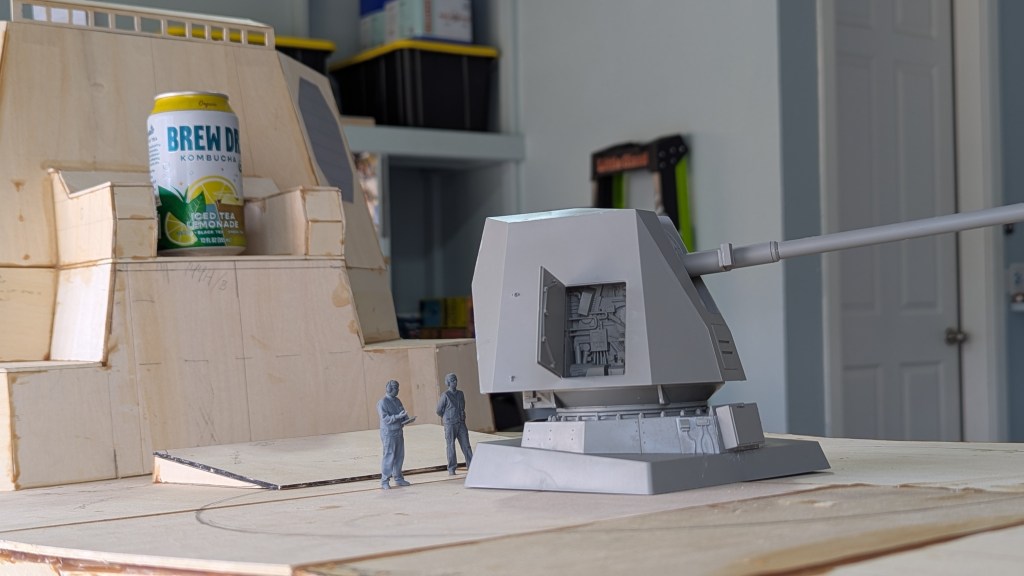
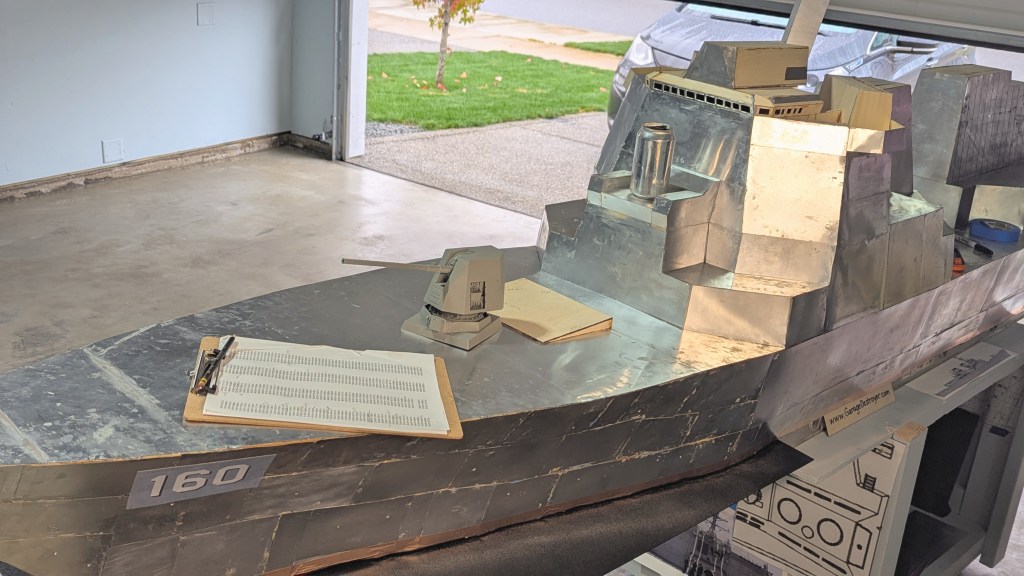
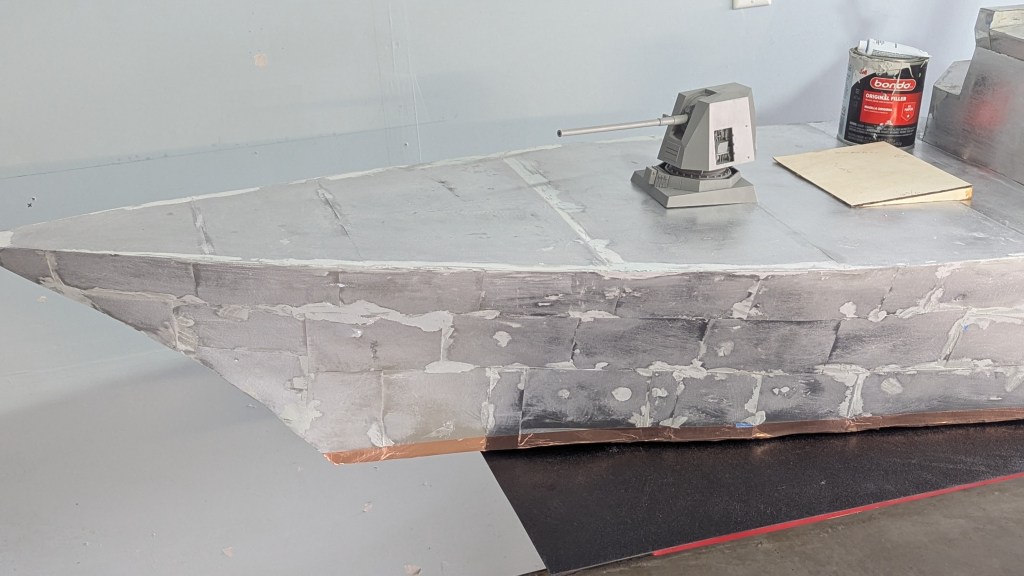
This nice pew pew is a Takom Mk.45 Mod 4 5"/62 Naval Gun kit. That gap at the bottom is my intentional transverse deck camber.
This kit was pretty easy to build. And yes of course it will get painted.
PHASE II: IT GETS METAL
Month three. One of my major goals for this model was that I wanted it clad entirely in metal, for an authentic appearance.
I tested a few different gauges and types of aluminum and settled on simple rolled roof flashing.
Every metal plating sheet was cut to fit, sanded and cleaned, and glued on to cover the atrocious wood hull.
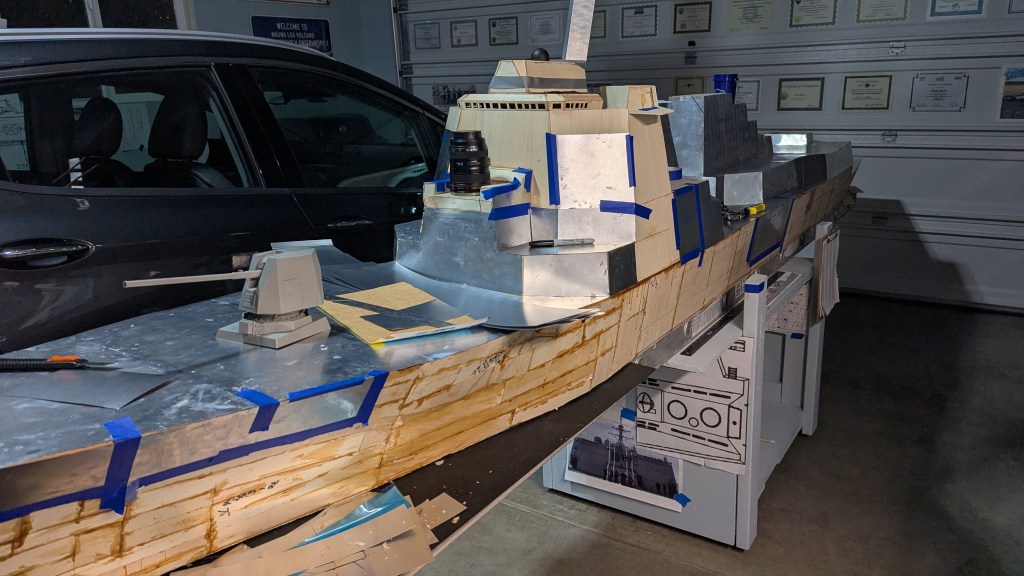
November: It's month four and I still have only a vague idea of what I'm doing but the metal hull plating is definitely a visual improvement. The whole thing is a little heavier now, but still much lighter than it looks.
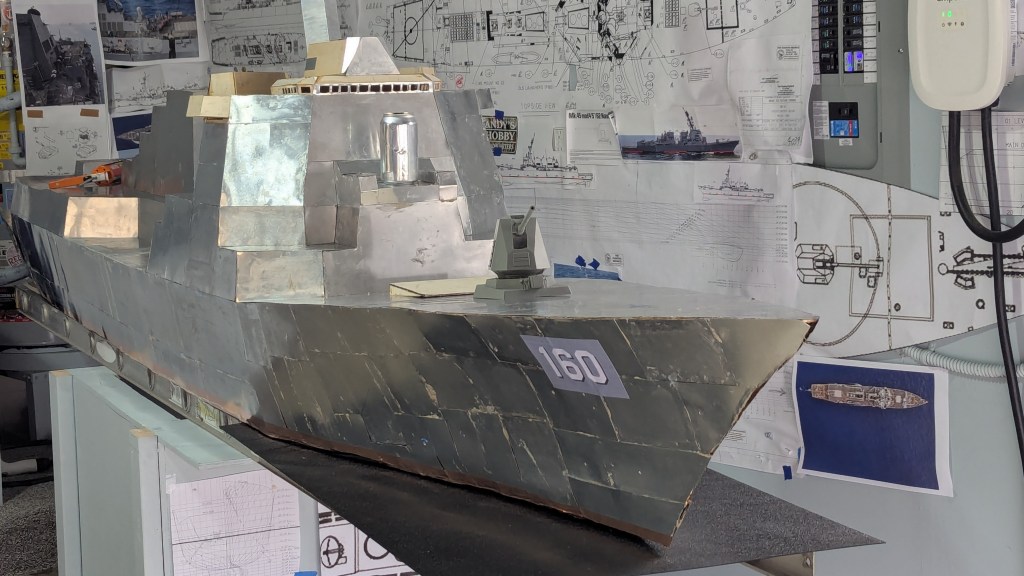
160 is a fictional future hull number. Now if somebody serving on a real DDG sees this and wants to give me a special deck tour to let me study their ship's details in person, I would gladly renumber and configure this model to match.
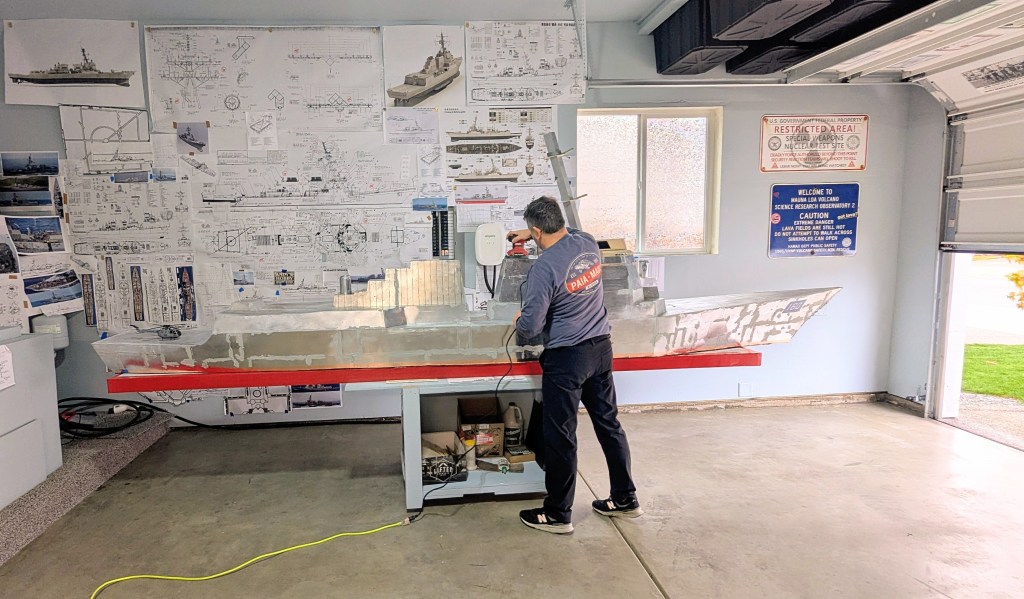
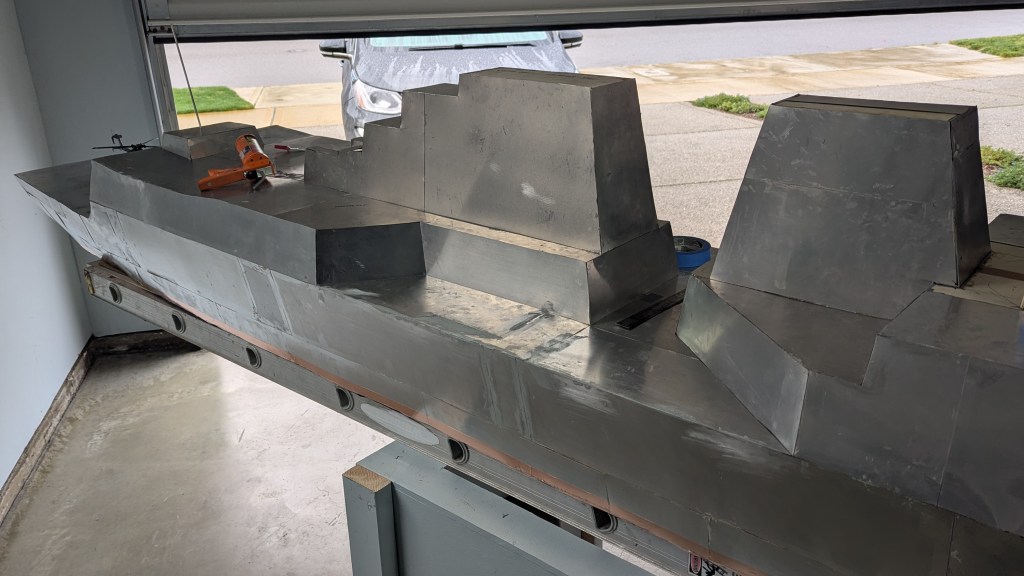
This is the under armor aluminum plating - another metal layer is going to cover all of this. And then there will be haze gray paint. And scale non-skid and railings and ladders and bitts and chocks and scuppers and VLS cell doors and just about everything else. SEWIP no, HELIOS yes. The cordless drill was the only power tool used so far. I'm aiming to be the quietest shipyard on the block.
I'm building this as a generic exhibition model of a Flight IIIA version, mod 2.4.8 which means it will be sporting as God intended both a Phalanx CIWS forward and a SeaRAM CIWS aft; a sadly rare configuration and confirmed to me as ideal by a former DDG commander who saw my model in an online forum and was suitably impressed. I was further encouraged by an experienced shipyard worker who saw this and told me it was looking pretty spot-on so far.
Surprising everybody, I managed to cut every piece of metal by hand with snips and scissors without any more blood loss.
I did however carelessly brush up against some of the ship's corners and edges and get some impressive scrapes.
Full Metal Jacket
After agonizing about the hangars, I decided to skip all the detail inside and plan for closed doors. In my defense, I'll point out that Phase V of this build will include the creation of a dynamic looking diorama on the flight deck featuring a hovering MH-60R and flight deck crew figures and we all know that a properly authentic naval flight operations scene requires the doors to be secured.
I know this will disappoint some of you but this model is not designed for radio control operation(s). Because as you can see, there's..uh..no lower hull. Mostly because I have space constraints. Also a complete and properly (re)engineered hull this large with an actual metal-plated superstructure would require a significant amount of ballast, in addition to running gear and batteries, which would make this thing well over 500 pounds GVW. And would then require a hoist and a specialized trailer.
This hand crafted XL scale guided missile destroyer model is apparently a one of a kind and probably the world's first; in all my research I have yet to see any model destroyer of this class anywhere near this stupid big or made with this construction method. It has attracted the attention of a few curious passers by when my garage door is open and more than one delivery driver has stopped to ogle this up close and personal.
When completed, this is going to either a deserving museum or a private buyer. idk . tbd. hmu.
My goal is a museum quality model, which means this will be outfitted with a lot of accurately detailed 3d resin printed parts and pieces including the fairlead and anchor and antennas and rigging and RHIBS and radars and radomes and UNREP transfer station identifiers, flight deck markings, flight deck nets, QAWDs, DVSS, deck tie downs, etc. et al. I was pleased to learn that "Museum quality" is a subjective standard, and at the rate I'm going it will definitely achieve that.
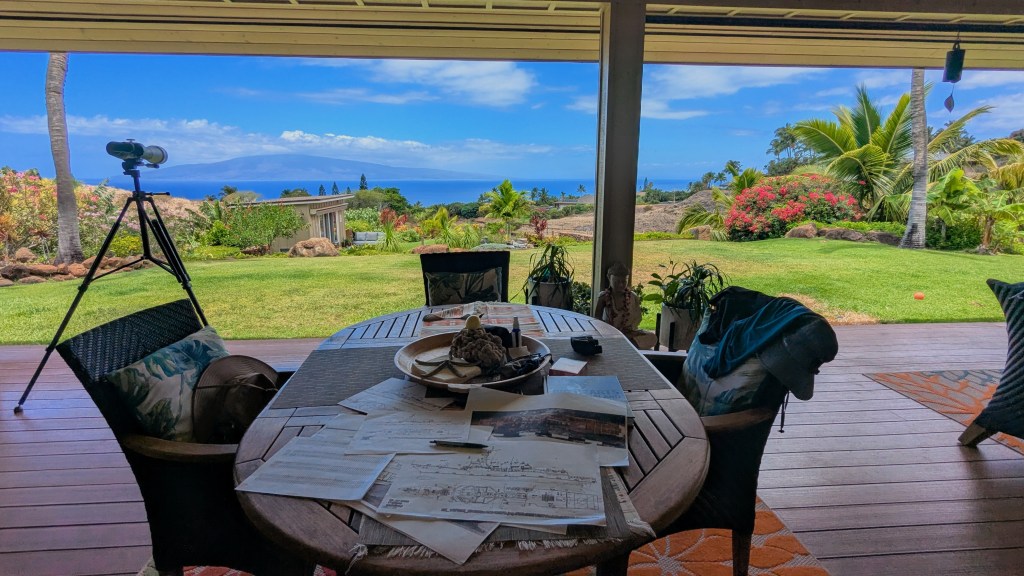
Any and every good boat project has to get ignored occasionally. But I admit I did bring along on a two week Hawaiian vacation a large stack of drawings to pore over and study.
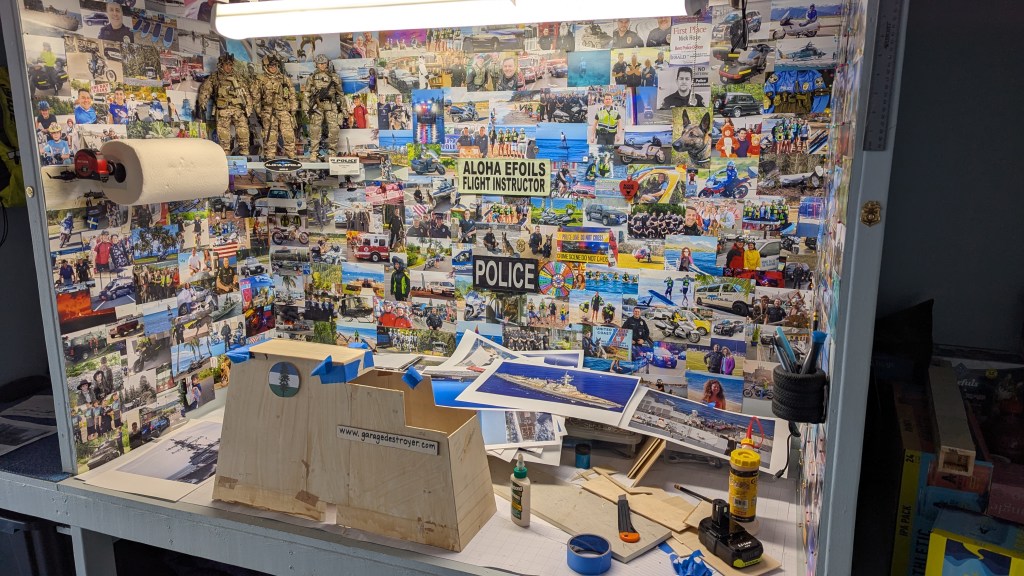
To answer a common question, the big prints of ships plans came from the floating drydock.com and the rest from various internet open sources. Of course the Navy does not share any of their official general arrangement deck plans or any other helpful technical details; I had to do my own research. Now that I've spent who knows how many hours studying literally thousands of saved reference photos from hundreds of internet sites, I can notice pretty quickly when the accuracy of much smaller scale plastic models of this ship class are not..quite..right. Same for quite a few of the computer 3d rendered models of these destroyers found online - virtually all of them have deficiencies in dimensions or features when closely inspected.
The navigation bridge windows here are placeholders and will upgraded. The clipboard has my scale conversion chart which I used constantly.
There are enough different build phases overlapping now that it gives me a fine variety of mini-projects to rotate among and work on.
December 2025: Month six. Time for the second power tool, in this case a cheap sander to smooth out the Bondo I smeared into and onto the joints. I did not realize how hard dried Bondo becomes.
Fifth month. The metal look is definitely more impressive than the wood, and fitting for a model this size. It's kind of starting to look recognizable as a model warship.
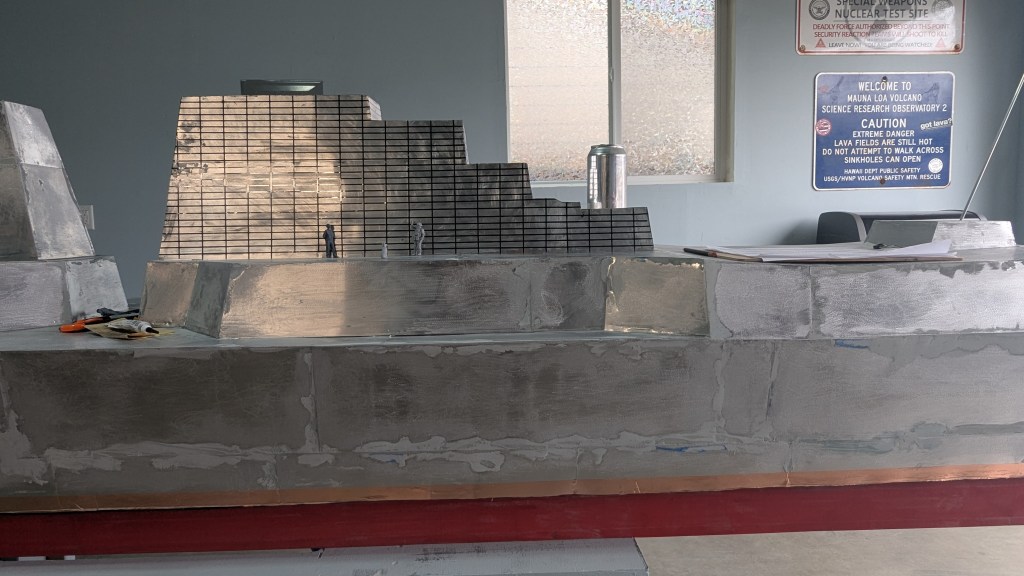
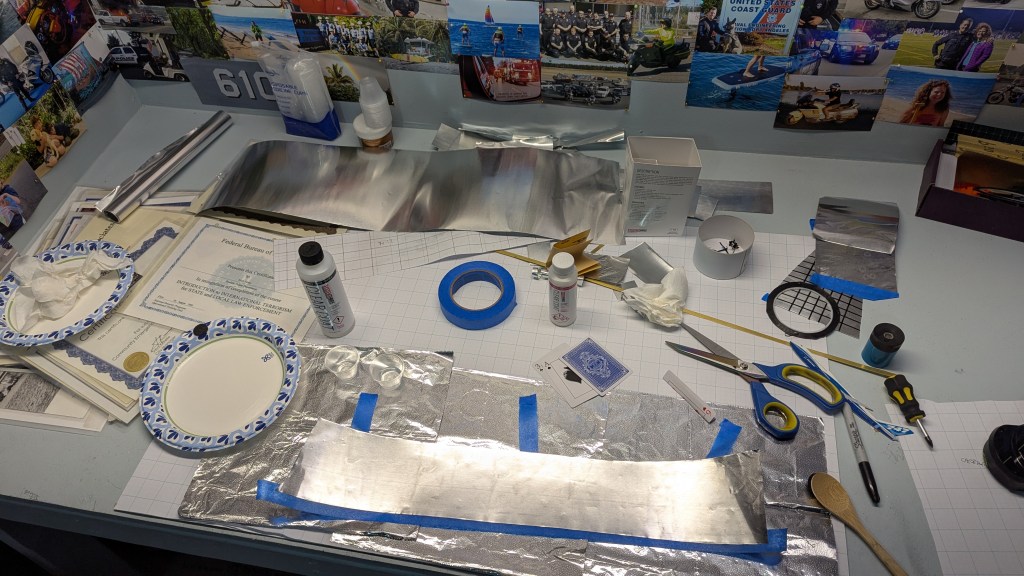
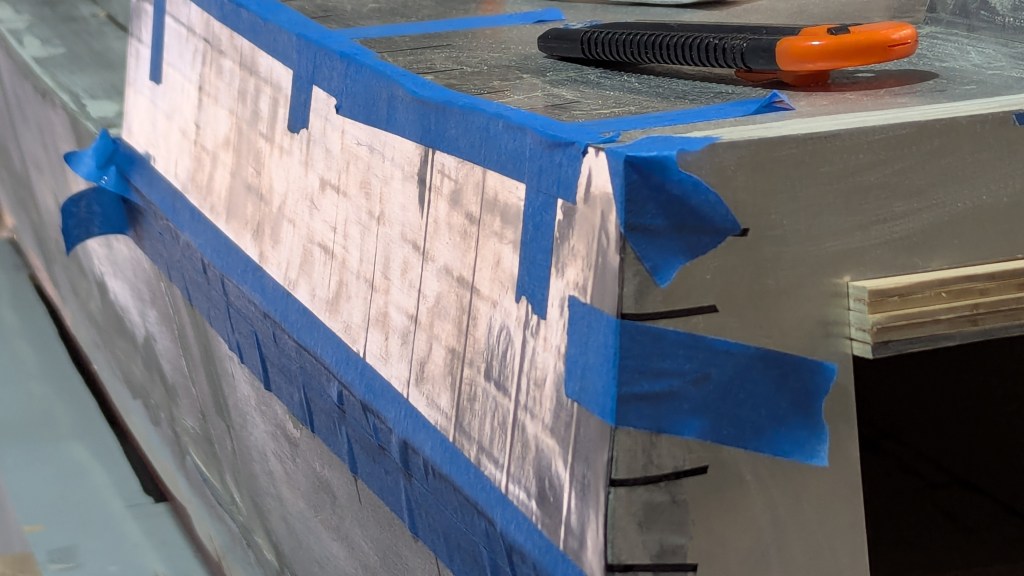
I'm replicating the framing with 3mm wide pinstripe vinyl tape, which will be covered with 36 gauge aluminum foil - thin enough to burnish and show authentic oil canning between the frames. Or so I hope. It was the best idea that I could come up with. The entire hull is going to get this treatment because a perfectly smooth hull at this scale would be just..wrong. And so accordingly, there will also be simulated scale weld bead lines.
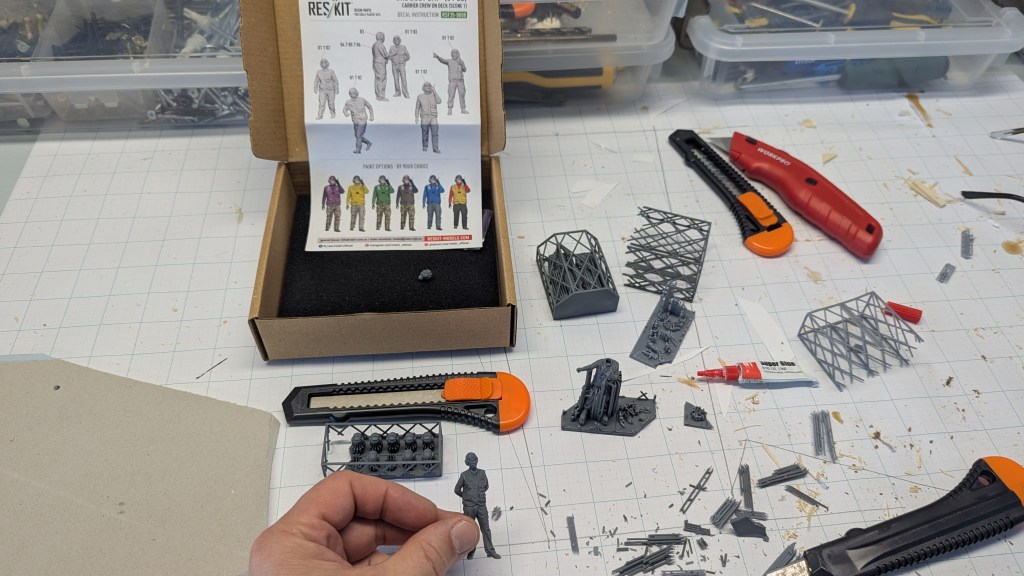
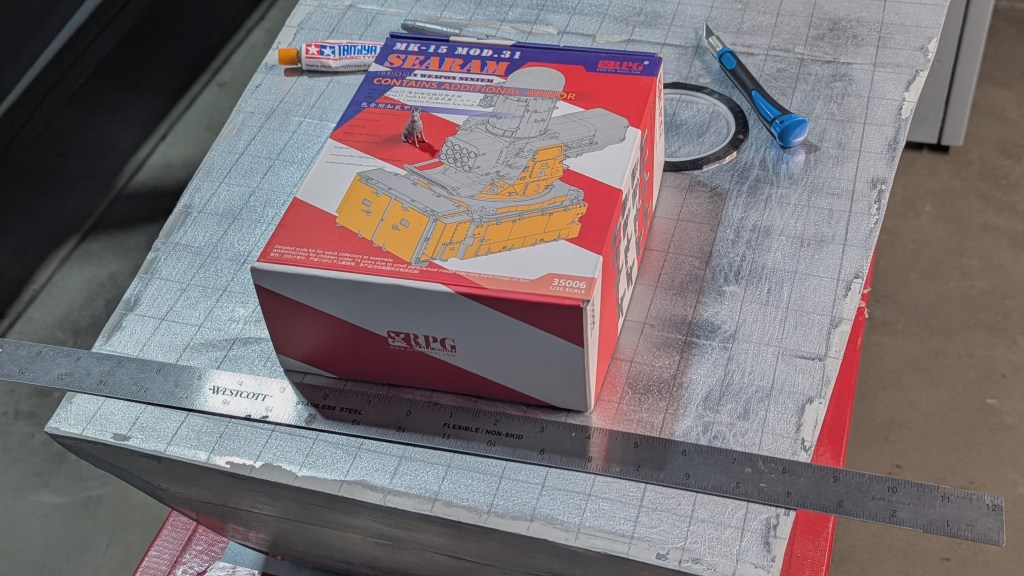
Progress has slowed considerably because it's winter and now my garage is effing cold. And I have one of those new hybrid water heaters that makes hot water and spews out cold air. Great in the summer. Not so much in the winter. That's okay, I'm inside gluing together stupidly small photo etched parts onto a scale plastic kit model of a sweeeet Mk 15 mod. 31 SeaRAM for the aft CIWS mount.
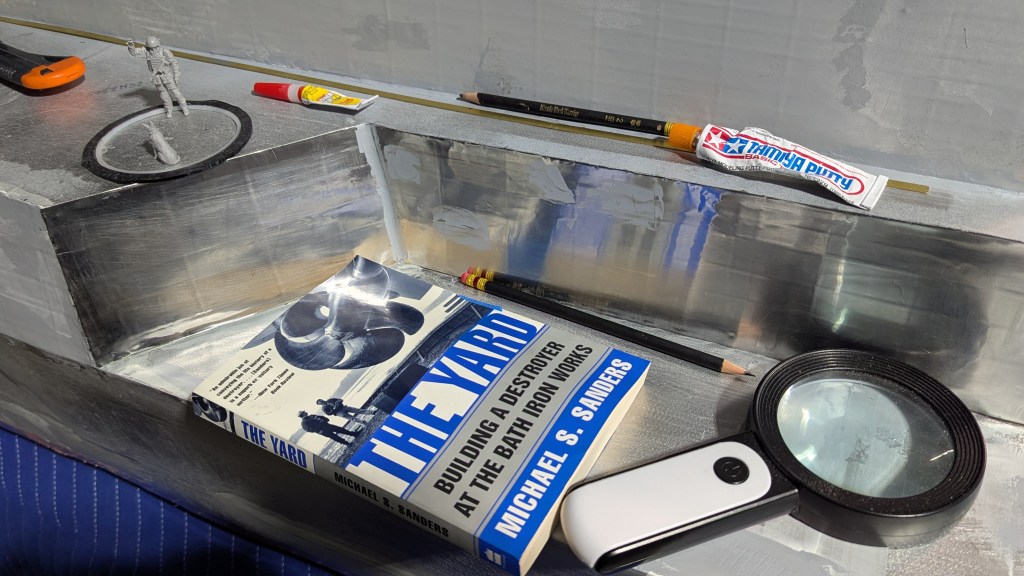
This ship is going to have quite a few scale model crew figurines all over because why not.
Everything will eventually be painted very authentically - I have a lot of prior professional experience with haze gray paint. And it will be appropriately weathered with simulated salt spray and aging and rust. Nothing is going to be glossy on this model when it's finished.
Maybe I'll finish it before an apocalypse.
January 2026
Month Seven
It's foil time.
I'm now starting to glue metal onto metal. Prep includes light sanding and cleaning with rubbing alcohol on the exterior of the inner plating and of course the matching inner side of the new and final cladding. For this application, I'm using a high viscosity two-part epoxy, applied paper thin to both the hull sections and the foil. After a couple days I carefully peel off the tape and tuck in edges and corners with some extra superglue.
Holy shit I think this might just work. I'm still just making this all up as I go along, powering through all kinds of interesting complications and challenges.
There will be a couple of sexy scale 1/35 RHIB's here, after this section gets like another 20 hours of fine detail work.
If you've made it this far and have questions OR CAN OFFER ME A TOUR OF A REAL SHIP at Naval Station Everett..drop me a line!






















 THE GARAGE DESTROYER